
CFD MODELLING

OVERVIEW

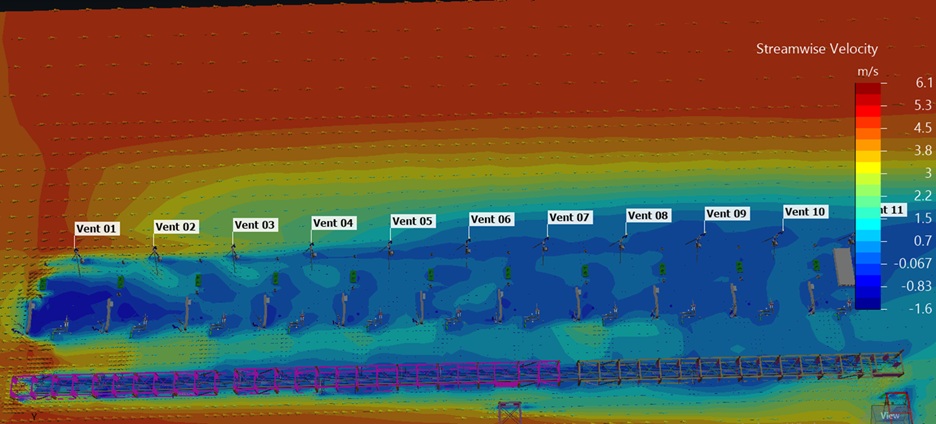
Computational Fluid Dynamics (CFD) Modelling is an advanced, physics-based simulation technique used to analyze complex fluid flow, gas dispersion, and fire behavior within Oil & Gas facilities.

By accurately representing facility geometry, congestion, ventilation, and environmental conditions, CFD provides high-fidelity insight into how hazardous releases evolve, spread, and impact personnel, equipment, and structures – far beyond the capability of simplified analytical methods.

Our CFD services include gas dispersion modelling, fire modelling (jet fire, pool fire, flash fire), thermal plume analysis, and CFD-based Fire & Gas Mapping, supporting performance-based design and risk assessment.

A CFD Thermal Plume Study is an advanced simulation used to analyze the behavior of hot gas releases and exhaust plumes within Oil & Gas facilities. Using Computational Fluid Dynamics (CFD), the study evaluates how high-temperature gases - such as flare emissions, turbine exhaust, or process vents - disperse, rise, and interact with surrounding structures under varying environmental conditions.
Read More
A CFD Fire & Gas (F&G) Mapping Study is a performance-based assessment that uses advanced Computational Fluid Dynamics (CFD) simulations to evaluate the effectiveness of fire and gas detection systems under realistic hazard scenarios. Unlike traditional geometric coverage methods, this approach models actual gas dispersion and fire behavior within the facility to assess how effectively detectors respond to credible releases - accounting for congestion, ventilation, wind, and layout complexity.
Read More
CFD Dispersion Modelling is an advanced simulation technique used to analyze the behavior of gas and vapor releases within complex Oil & Gas facilities. Using Computational Fluid Dynamics (CFD), the study captures the influence of geometry, congestion, ventilation, and wind conditions on the dispersion of flammable and toxic gases - providing a highly realistic representation of how hazardous clouds form, spread, and accumulate.
Read More
CFD Fire Modelling is an advanced, physics-based simulation used to analyze fire behavior and its impact within complex Oil & Gas facilities. Using Computational Fluid Dynamics (CFD), the study captures detailed flame characteristics, heat distribution, smoke movement, and interaction with surrounding structures - providing a realistic representation of fire scenarios beyond traditional simplified methods.
Read More